

Alliteration Used In The Raven
"The Raven" by Edgar Allan Poe is one of the most well-known poems ever written. It brought its writer worldwide fame and has frequently been analyzed, performed, and parodied. But what nearly this poem makes information technology then special? In this guide, we requite you a complete overview of "The Raven," discussing everything from the deplorable stories backside its cosmos and what is actually going on between the narrator and the raven, to its themes and the poetic devices it uses so finer. Beneath is the consummate text of The Raven poem, written by Edgar Allan Poe and published in 1845. It consists of 18 stanzas and a full of 108 lines. Once upon a midnight dreary, while I pondered, weak and weary, Over many a quaint and curious volume of forgotten lore— While I nodded, nearly napping, suddenly in that location came a tapping, Every bit of some one gently rapping, rapping at my chamber door. "'Tis some visitor," I muttered, "borer at my chamber door— Simply this and naught more." Ah, distinctly I remember it was in the bleak Dec; And each separate dying ember wrought its ghost upon the floor. Eagerly I wished the morrow;—vainly I had sought to borrow From my books surcease of sorrow—sorrow for the lost Lenore— For the rare and radiant maiden whom the angels proper name Lenore— Nameless here for evermore. And the silken, pitiful, uncertain rustling of each purple curtain Thrilled me—filled me with fantastic terrors never felt before; So that now, to all the same the beating of my heart, I stood repeating "'Tis some visitor entreating entrance at my bedroom door— Some late visitor entreating entrance at my chamber door;— This it is and nothing more than." Presently my soul grew stronger; hesitating then no longer, "Sir," said I, "or Madam, truly your forgiveness I implore; But the fact is I was napping, and so gently you came rapping, And and then faintly yous came tapping, tapping at my chamber door, That I scarce was sure I heard you lot"—hither I opened broad the door;— Darkness at that place and goose egg more. Deep into that darkness peering, long I stood there wondering, fearing, Doubting, dreaming dreams no mortal e'er dared to dream before; But the silence was unbroken, and the stillness gave no token, And the just word there spoken was the whispered word, "Lenore?" This I whispered, and an echo murmured back the word, "Lenore!"— Simply this and cipher more than. Dorsum into the bedroom turning, all my soul within me burning, Presently again I heard a borer somewhat louder than before. "Surely," said I, "surely that is something at my window lattice; Let me encounter, then, what thereat is, and this mystery explore— Let my heart be still a moment and this mystery explore;— 'Tis the wind and zilch more!" Open here I flung the shutter, when, with many a flirt and flutter, In there stepped a stately Raven of the saintly days of yore; Not the to the lowest degree obeisance made he; not a infinitesimal stopped or stayed he; But, with mien of lord or lady, perched to a higher place my chamber door— Perched upon a bosom of Pallas just to a higher place my chamber door— Perched, and sat, and zip more. Then this ebony bird beguiling my sad fancy into grin, By the grave and stern decorum of the countenance it wore, "Though thy crest be shorn and shaven, thou," I said, "fine art sure no craven, Ghastly grim and ancient Raven wandering from the Nightly shore— Tell me what thy lordly name is on the Night's Plutonian shore!" Quoth the Raven "Nevermore." Much I marvelled this ungainly fowl to hear discourse so plainly, Though its answer petty meaning—niggling relevancy bore; For we cannot help like-minded that no living human being Ever yet was blessed with seeing bird in a higher place his sleeping room door— Bird or fauna upon the sculptured bust higher up his chamber door, With such name as "Nevermore." Simply the Raven, sitting alone on the placid bosom, spoke only That one word, as if his soul in that i word he did outpour. Nothing farther and then he uttered—non a plumage so he fluttered— Till I scarcely more than muttered "Other friends accept flown earlier— On the morrow he will leave me, as my Hopes have flown earlier." Then the bird said "Nevermore." Startled at the stillness broken by answer so aptly spoken, "Doubtless," said I, "what information technology utters is its only stock and store Caught from some unhappy master whom unmerciful Disaster Followed fast and followed faster till his songs one burden bore— Till the dirges of his Hope that melancholy brunt bore Of 'Never—nevermore'." Simply the Raven nevertheless beguiling all my fancy into smiling, Straight I wheeled a cushioned seat in forepart of bird, and bust and door; And then, upon the velvet sinking, I betook myself to linking Fancy unto fancy, thinking what this ominous bird of yore— What this grim, ungainly, ghastly, gaunt, and ominous bird of yore Meant in croaking "Nevermore." This I sabbatum engaged in guessing, simply no syllable expressing To the fowl whose fiery eyes now burned into my bosom's cadre; This and more I sat divining, with my caput at ease reclining On the cushion's velvet lining that the lamp-calorie-free gloated o'er, But whose velvet-violet lining with the lamp-low-cal gloating o'er, She shall press, ah, nevermore! So, methought, the air grew denser, perfumed from an unseen censer Swung by Seraphim whose foot-falls tinkled on the tufted floor. "Wretch," I cried, "thy God hath lent thee—past these angels he hath sent thee Respite—respite and nepenthe from thy memories of Lenore; Carouse, oh quaff this kind nepenthe and forget this lost Lenore!" Quoth the Raven "Nevermore." "Prophet!" said I, "thing of evil!—prophet even so, if bird or devil!— Whether Tempter sent, or whether tempest tossed thee hither ashore, Desolate yet all undaunted, on this desert country enchanted— On this home past Horror haunted—tell me truly, I implore— Is at that place—is there balm in Gilead?—tell me—tell me, I implore!" Quoth the Raven "Nevermore." "Prophet!" said I, "thing of evil!—prophet yet, if bird or devil! By that Heaven that bends above u.s.a.—by that God we both adore— Tell this soul with sorrow laden if, within the afar Aidenn, It shall squeeze a sainted maiden whom the angels name Lenore— Clasp a rare and radiant maiden whom the angels proper name Lenore." Quoth the Raven "Nevermore." "Be that give-and-take our sign of departing, bird or fiend!" I shrieked, upstarting— "Get thee dorsum into the tempest and the Night's Plutonian shore! Leave no black feather as a token of that prevarication thy soul hath spoken! Exit my loneliness unbroken!—quit the bust higher up my door! Accept thy bill from out my heart, and take thy class from off my door!" Quoth the Raven "Nevermore." And the Raven, never flitting, nevertheless is sitting, even so is sitting On the pallid bust of Pallas just above my sleeping accommodation door; And his eyes take all the seeming of a demon's that is dreaming, And the lamp-calorie-free o'er him streaming throws his shadow on the flooring; And my soul from out that shadow that lies floating on the floor Shall be lifted—nevermore! "The Raven" is a poem about a man who is heartbroken over the contempo death of his dear Lenore. As he passes a alone December night in his room, a raven taps repeatedly on the door and so the window. The man get-go thinks the racket is caused by a late night visitor come up to disturb him, and he is surprised to find the raven when he opens the window shutter. After existence allow in, the raven flies to and lands on a bust of Pallas (an aboriginal Greek goddess of wisdom). The human is amused past how serious the raven looks, and he begins talking to the raven; nonetheless, the bird can only reply by croaking "nevermore." The man reflects aloud that the bird will leave him presently equally all the people he cared near have left him. When the raven replies "nevermore," the human being takes it every bit the bird agreeing with him, although it's unclear if the raven actually understands what the man is saying or is just speaking the one word it knows. As the man continues to antipodal with the bird, he slowly loses his grip on reality. He moves his chair directly in front of the raven and asks it despairing questions, including whether he and Lenore will be reunited in heaven. Now, instead of being merely amused by the bird, he takes the raven's repeated "nevermore" response as a sign that all his dark thoughts are true. He eventually grows angry and shrieks at the raven, calling information technology a devil and a thing of evil. The poem ends with the raven nevertheless sitting on the bust of Pallas and the narrator, seemingly defeated past his grief and madness, declaring that his soul shall be lifted "nevermore." Edgar Allan Poe wrote "The Raven" during a difficult period in his life. His wife, Virginia, was suffering from tuberculosis, Poe was struggling to make money as an unknown writer, and he began drinking heavily and picking fights with coworkers and other writers. It's easy to see how he could have conjured the night and melancholy mood of "The Raven." It's not known how long Poe spent writing "The Raven," (guesses range from anywhere to a unmarried twenty-four hours to over a decade) but information technology's thought most likely that he wrote the poem in the summer of 1844. In his essay, "The Philosophy of Composition," Poe stated that he chose to focus the poem on the death of a cute adult female because information technology is "unquestionably the most poetical topic in the world." He hoped "The Raven" would make him famous, and, in the same essay, stated that he purposely wrote the poem to entreatment to both "the popular and the disquisitional gustatory modality." "The Raven" was published in the paper The New York Evening Mirror on January 29, 1845 (depending on the source, Poe was paid either $9 or $15 for it). "The Raven" brought Poe instant fame, although not the financial security he was looking for. Critical reception was mixed, with some famous writers such equally Ralph Waldo Emerson and William Butler Yeats expressing their dislike for the poem. Despite those initial mixed reviews, The Raven poem has continued its popularity and is now one of the most well-known poems in the world. Countless parodies take been written, and the poem has been referenced in everything from The Simpsons to the NFL team the Baltimore Ravens (their mascot is even named "Poe"). From The Raven summary, we know it's definitely a melancholy verse form, and about of its themes circumduct around grim topics. Here are three of the most important themes. Grief is the overwhelming emotion in "The Raven," and the narrator is absolutely consumed by his grief for his lost honey, Lenore. At the beginning of the verse form, he tries to distract himself from his sadness by reading a "book of forgotten lore", but when the raven arrives, he immediately begins peppering information technology with questions about Lenore and becomes further lost in his grief at the raven's response of "nevermore." Past the stop of the poem, the narrator is seemingly cleaved, stating that his soul will never again be "lifted" due to his sadness. Poe stated that the raven itself was a symbol of grief, specifically, that information technology represented "mournful and never-ending remembrance." He purposely chose a raven over a parrot (a bird species better known for its ability to speak) because he thought a raven suited the dark tone of the poem better. Edgar Allan Poe had experienced a cracking deal of grief past the time he wrote "The Raven," and he had seen people shut to him leave, fall gravely sick, or dice. He would take been well aware of the consuming power that grief can have and how it has the ability to blot everything else out. It'due south the narrator's deep love for Lenore that causes him such grief, and later rage and madness. Fifty-fifty though Lenore has died, the narrator however loves her and appears unable to recall of annihilation just her. In the poem, he speaks of Lenore in superlatives, calling her "sainted" and "radiant." In his mind, she is completely perfect, practically a saint. His honey for this adult female who is no longer hither distracts him from everything in his current life. With this theme, Poe is showing the power of love and how it can go along to be powerful even after death. At the outset of the poem, the narrator is rational enough to understand that Lenore is dead and he will not see her again. When the raven starting time begins repeating "nevermore," he realizes that the reply is the bird'south "but stock and store," and he won't become some other response no affair what he asks. He seems to fifty-fifty discover the bird vaguely amusing. However, equally the poem continues, the narrator'south irrationality increases equally he asks the raven questions information technology couldn't possibly know and takes its repeated response of "nevermore" to be a truthful and logical answer. He and then descends farther into madness, blasphemous the bird as a "devil" and "thing of evil" and thinking he feels angels surrounding him before sinking into his grief. He has clearly come undone by the end of the poem. In "The Raven," Poe wanted to evidence the fine line between rational thought and madness and how strong emotions, such equally grief, tin can push button a person into irrationality, even during mundane interactions similar the one the narrator had with the raven. Edgar Allan Poe makes apply of many poetic devices in "The Raven" to create a memorable and moving slice of writing. Below we discuss seven of the most important of these devices and how they contribute to the poem. An innuendo is an indirect reference to something, and Poe makes multiple allusions in "The Raven." Some key ones include: The bust of Pallas the raven sits on refers to Pallas Athena, the ancient Greek goddess of wisdom. Nepenthe is a drug mentioned in Homer'south ancient ballsy The Odyssey, and it is purported to erase memories. The Balm of Gilead is a reference to a healing cream mentioned in the Book of Jeremiah in the Bible. Aidenn refers to the Garden of Eden, although the narrator likely uses it to mean "heaven" in general, as he wants to know if that's where he and Lenore will reunite. Ravens themselves are mentioned in many stories, including Norse mythology and Ovid's epic verse form Metamorphoses. The majority of "The Raven" follows trochaic octameter, which is when at that place are 8 trochaic feet per line, and each foot has ane stressed syllable followed by one unstressed syllable. Notwithstanding, Poe actually used several types of meter, and he is said to have based both the meter and rhyming pattern of "The Raven" off Elizabeth Barrett's poem " Lady Geraldine'due south Courtship." Meter is very prominent in "The Raven," and, along with other poetic devices, helps make it such a popular poem to recite. The rhyming pattern in "The Raven" follows the pattern ABCBBB. The "B" lines all rhyme with "nevermore" and place additional emphasis on the final syllable of the line. There is as well quite a bit of internal rhyme within the poem, such as the line "But the silence was unbroken, and the stillness gave no token," where "unbroken" rhymes with "token." Internal rhyming occurs in the offset line of each stanza. Information technology also occurs in the tertiary line and function of the fourth line of each stanza. In the instance "Exit no black plume as a token of that lie thy soul hath spoken!/Exit my loneliness unbroken!—quit the bust above my door!" "token" and "spoken" in the third line of the stanza rhyme with "unbroken" in the 4th line of the stanza. Onomatopoeia is when the name of a word is associated with the sound it makes, and it occurs throughout "The Raven," such as with the words "rapping," "tapping," "shrieked," and "whispered." It all helps add to the atmospheric quality of the poem and makes readers feel equally though they are actually in the room with the narrator and the raven. "Ozymandias" by Percy Shelley is another famous and oft-studied poem. Larn all well-nigh this poem and its famous line "expect on my works, ye mighty, and despair" in our complete guide to Ozymandias. In that location are many more poetic devices than those included in "The Raven." Read our guide on the 20 poetic devices you need to know and so you lot tin can become an proficient. Taking AP Literature? Nosotros've got you covered! In our skilful guide to the AP Literature exam, we've compiled all the information you need to know well-nigh the examination and how to study for it to get a summit score. Demand more than help with this topic? Check out Tutorbase! Our vetted tutor database includes a range of experienced educators who can help you polish an essay for English or explain how derivatives work for Calculus. You lot can use dozens of filters and search criteria to notice the perfect person for your needs. 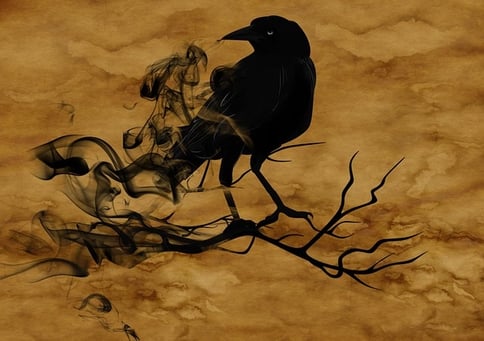
The Raven Poem: Full Text
What Is "The Raven" Nigh?
Groundwork on "The Raven"
Major Themes in "The Raven"
Theme 1: Grief
Theme 2: Devotion
Theme 3: Rationality vs Irrationality
The 7 Key Poetic Devices "The Raven" Uses
Ingemination
Alliteration is the repetition of a audio or alphabetic character at the outset of multiple words in a piece of work, and it'south perhaps the nearly obvious poetic device in "The Raven." The poem is full of alliteration, such as the phrases "weak and weary," "nearly napping," and "followed fast and followed faster." This poetic device helps requite the poem its famous musicality and is 1 of the reasons people love to recite it.
Allusion
Many readers would be well-versed in the books and stories alluded to in the verse form, and they would take understood the references without Poe having to explicitly explicate where each was derived from. Doing so would have broken the tension and mood of the verse form, so Poe is able to simply allude to them.
Assonance
Similar to alliteration, assonance is the repetition of vowel sounds in 1 or more than words found close together. It serves the aforementioned purpose equally alliteration and appears beginning in the first line of the poem, where the long "due east" audio is repeated in the words "dreary," "weak," and "weary."
Meter
Repetition
Many words are repeated in "The Raven" the well-nigh famous existence the word "nevermore" repeated by the bird himself throughout the poem. Other commonly repeated words and phrases in the verse form include "Lenore," "chamber door" and "nix more." These all rhyme with "nevermore" and add to the feeling of despondency in the verse form by emphasizing the raven'southward bleak answer to every question.
Rhyme
Onomatopoeia
What's Next?


Christine graduated from Michigan Land University with degrees in Environmental Biology and Geography and received her Main's from Knuckles University. In loftier school she scored in the 99th percentile on the SAT and was named a National Merit Finalist. She has taught English and biological science in several countries.

Alliteration Used In The Raven,
Source: https://blog.prepscholar.com/the-raven-poem-summary
Posted by: eilermansuppen.blogspot.com
0 Response to "Alliteration Used In The Raven"
Post a Comment