

Fcc Unit Cell Edge Length
Unit Cells
Unit of measurement Cells: The Simplest Repeating Unit of measurement in a Crystal
The construction of solids can be described as if they were three-dimensional analogs of a piece of wallpaper. Wallpaper has a regular repeating design that extends from ane edge to the other. Crystals accept a similar repeating design, only in this instance the pattern extends in three dimensions from ane edge of the solid to the other.
Nosotros can unambiguously describe a piece of wallpaper by specifying the size, shape, and contents of the simplest repeating unit in the design. Nosotros can depict a three-dimensional crystal by specifying the size, shape, and contents of the simplest repeating unit and the mode these repeating units stack to form the crystal.
The simplest repeating unit in a crystal is called a unit of measurement jail cell. Each unit of measurement prison cell is defined in terms of lattice points the points in space well-nigh which the particles are gratis to vibrate in a crystal.
The structures of the unit cell for a variety of salts are shown below.
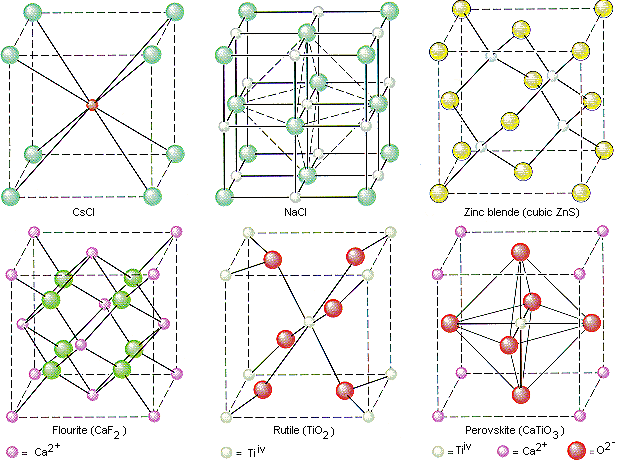
In 1850, Auguste Bravais showed that crystals could be divided into 14 unit cells, which meet the post-obit criteria.
- The unit prison cell is the simplest repeating unit of measurement in the crystal.
- Opposite faces of a unit of measurement jail cell are parallel.
- The border of the unit cell connects equivalent points.
The 14 Bravais unit cells are shown in the effigy below.
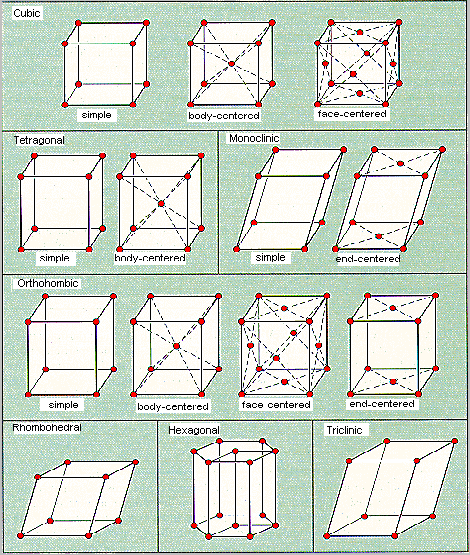
These unit cells fall into seven categories, which differ in the iii unit of measurement-cell edge lengths (a, b, and c) and three internal angles (a, � and thou), as shown in the table below.
The Seven Categories of Bravais Unit Cells
Nosotros will focus on the cubic category, which includes the three types of unit cellssimple cubic, body-centered cubic, and face up-centered cubicshown in the figure below.
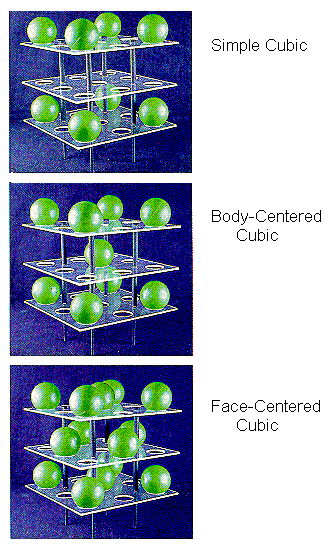
These unit cells are of import for two reasons. First, a number of metals, ionic solids, and intermetallic compounds crystallize in cubic unit cells. Second, information technology is relatively easy to practice calculations with these unit cells considering the prison cell-border lengths are all the same and the jail cell angles are all 90.
The simple cubic unit of measurement cell is the simplest repeating unit in a simple cubic structure. Each corner of the unit cell is defined by a lattice indicate at which an atom, ion, or molecule tin can exist plant in the crystal. By convention, the edge of a unit jail cell ever connects equivalent points. Each of the 8 corners of the unit cell therefore must comprise an identical particle. Other particles tin can exist present on the edges or faces of the unit cell, or inside the body of the unit jail cell. But the minimum that must be present for the unit cell to exist classified as unproblematic cubic is eight equivalent particles on the 8 corners.
The body-centered cubic unit prison cell is the simplest repeating unit in a body-centered cubic structure. Once again, at that place are eight identical particles on the 8 corners of the unit cell. However, this time there is a ninth identical particle in the center of the body of the unit cell.
The face up-centered cubic unit jail cell also starts with identical particles on the 8 corners of the cube. Only this structure likewise contains the same particles in the centers of the six faces of the unit cell, for a full of 14 identical lattice points.
The face up-centered cubic unit jail cell is the simplest repeating unit in a cubic closest-packed structure. In fact, the presence of face-centered cubic unit cells in this structure explains why the structure is known as cubic closest-packed.

Unit Cells: A Three-Dimensional Graph
The lattice points in a cubic unit cell tin be described in terms of a 3-dimensional graph. Considering all iii cell-border lengths are the aforementioned in a cubic unit cell, it doesn't affair what orientation is used for the a, b, and c axes. For the sake of argument, we'll define the a axis as the vertical axis of our coordinate system, equally shown in the effigy beneath.
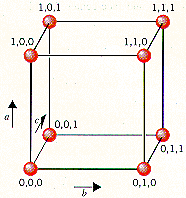
The b axis will then depict movement across the front of the unit of measurement cell, and the c axis will represent motility toward the dorsum of the unit cell. Furthermore, we'll arbitrarily define the lesser left corner of the unit cell as the origin (0,0,0). The coordinates 1,0,0 signal a lattice point that is one prison cell-border length abroad from the origin along the a centrality. Similarly, 0,1,0 and 0,0,ane stand for lattice points that are displaced by ane cell-edge length from the origin along the b and c axes, respectively.
Thinking almost the unit of measurement cell as a three-dimensional graph allows us to describe the structure of a crystal with a remarkably pocket-size corporeality of information. We tin specify the structure of cesium chloride, for case, with only 4 pieces of information.
- CsCl crystallizes in a cubic unit of measurement prison cell.
- The length of the unit cell edge is 0.4123 nm.
- There is a Cl- ion at the coordinates 0,0,0.
- In that location is a Cs+ ion at the coordinates i/2,1/ii,1/ii.
Because the cell edge must connect equivalent lattice points, the presence of a Cl- ion at one corner of the unit cell (0,0,0) implies the presence of a Cl- ion at every corner of the cell. The coordinates 1/2,ane/2,1/ii depict a lattice betoken at the center of the cell. Because there is no other point in the unit cell that is one cell-border length away from these coordinates, this is the merely Cs+ ion in the cell. CsCl is therefore a uncomplicated cubic unit jail cell of Cl- ions with a Cs+ in the center of the body of the cell.
Unit Cells: NaCl and ZnS
NaCl should crystallize in a cubic closest-packed assortment of Cl- ions with Na+ ions in the octahedral holes betwixt planes of Cl- ions. We can translate this information into a unit of measurement-jail cell model for NaCl by remembering that the confront-centered cubic unit prison cell is the simplest repeating unit in a cubic closest-packed structure.
There are iv unique positions in a confront-centered cubic unit cell. These positions are defined by the coordinates: 0,0,0; 0,1/2,1/ii; i/2,0,1/two; and one/2,1/two,0. The presence of an particle at 1 corner of the unit cell (0,0,0) requires the presence of an equivalent particle on each of the eight corners of the unit cell. Because the unit-cell edge connects equivalent points, the presence of a particle in the center of the bottom confront (0,1/2,i/2) implies the presence of an equivalent particle in the center of the top face (one,1/2,1/2). Similarly, the presence of particles in the center of the ane/2,0,ane/two and 1/2,1/2,0 faces of the unit cell implies equivalent particles in the centers of the 1/ii,1,1/2 and 1/two,i/2,1 faces.
The figure below shows that there is an octahedral pigsty in the center of a face up-centered cubic unit cell, at the coordinates 1/two,i/two,1/2. Any particle at this point touches the particles in the centers of the six faces of the unit cell.
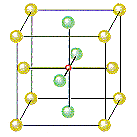
The other octahedral holes in a face-centered cubic unit cell are on the edges of the cell, as shown in the figure below.

If Cl- ions occupy the lattice points of a confront-centered cubic unit cell and all of the octahedral holes are filled with Na+ ions, nosotros get the unit cell shown in the figure below.
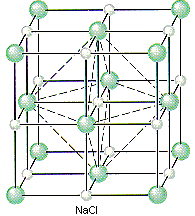
We can therefore depict the structure of NaCl in terms of the post-obit information.
- NaCl crystallizes in a cubic unit prison cell.
- The cell-edge length is 0.5641 nm.
- There are Cl- ions at the positions 0,0,0; 1/two,one/2,0; 1/2,0,i/2; and 0,one/2,1/2.
- In that location are Na+ ions at the positions one/2,1/two,ane/2; 1/2,0,0; 0,1/2,0; and 0,0,1/2.
Placing a Cl- ion at these four positions implies the presence of a Cl- ion on each of the 14 lattice points that define a face-centered cubic unit. Placing a Na+ ion in the center of the unit cell (one/ii,1/2,one/2) and on the three unique edges of the unit of measurement cell (i/2,0,0; 0,1/2,0; and 0,0,1/two) requires an equivalent Na+ ion in every octahedral hole in the unit cell.
ZnS crystallizes equally cubic closest-packed array of S2- ions with Zntwo+ ions in tetrahedral holes. The Stwo- ions in this crystal occupy the aforementioned positions equally the Cl- ions in NaCl. The but difference between these crystals is the location of the positive ions. The figure below shows that the tetrahedral holes in a confront-centered cubic unit prison cell are in the corners of the unit cell, at coordinates such every bit i/4,1/4,1/4. An cantlet with these coordinates would touch the cantlet at this corner as well every bit the atoms in the centers of the three faces that grade this corner. Although it is difficult to run into without a 3-dimensional model, the four atoms that surround this pigsty are bundled toward the corners of a tetrahedron.
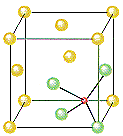
Because the corners of a cubic unit cell are identical, there must exist a tetrahedral hole in each of the eight corners of the confront-centered cubic unit cell. If S2- ions occupy the lattice points of a face-centered cubic unit cell and Zn2+ ions are packed into every other tetrahedral hole, we get the unit prison cell of ZnS shown in the figure below.
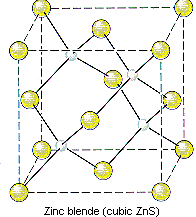
The structure of ZnS can therefore be described as follows.
- ZnS crystallizes in a cubic unit prison cell.
- The cell-border length is 0.5411 nm.
- There are Due south2- ions at the positions 0,0,0; 1/2,i/2,0; 1/2,0,1/2; and 0,1/2,1/2.
- There are Znii+ ions at the positions 1/4,one/iv,1/4; 1/4,3/four,3/4; 3/4,ane/4,3/4; and 3/4,three/4,i/4.
Note that only one-half of the tetrahedral holes are occupied in this crystal because there are two tetrahedral holes for every S2- ion in a closest-packed array of these ions.
Unit Cells: Measuring the Altitude Between Particles
Nickel is 1 of the metals that crystallize in a cubic closest-packed structure. When you consider that a nickel cantlet has a mass of only 9.75 x 10⁻²³ one thousand and an ionic radius of only one.24 x 10-x thousand, it is a remarkable accomplishment to be able to describe the construction of this metallic. The obvious question is: How exercise nosotros know that nickel packs in a cubic closest-packed construction?
The only way to determine the structure of affair on an atomic calibration is to apply a probe that is even smaller. One of the most useful probes for studying thing on this scale is electromagnetic radiation.
In 1912, Max van Laue plant that ten-rays that struck the surface of a crystal were diffracted into patterns that resembled the patterns produced when light passes through a very narrow slit. Shortly thereafter, William Lawrence Bragg, who was just completing his undergraduate caste in physics at Cambridge, explained van Laue's resultswith an equation known as the Bragg equation, which allows us to summate the altitude betwixt planes of atoms in a crystal from the blueprint of diffraction of x-rays of known wavelength.
n = iid sin T
The pattern by which x-rays are diffracted past nickel metal suggests that this metal packs in a cubic unit jail cell with a altitude betwixt planes of atoms of 0.3524 nm. Thus, the cell-edge length in this crystal must be 0.3524 nm. Knowing that nickel crystallizes in a cubic unit cell is non enough. Nosotros still have to decide whether information technology is a simple cubic, torso-centered cubic, or face-centered cubic unit cell. This can be washed past measuring the density of the metallic.
Unit Cells: Determining the Unit Cell of a Crystal
Atoms on the corners, edges, and faces of a unit of measurement cell are shared by more than ane unit cell, equally shown in the effigy below. An atom on a face is shared by two unit cells, so simply half of the atom belongs to each of these cells. An atom on an border is shared by iv unit cells, and an atom on a corner is shared by eight unit cells. Thus, just one-quarter of an atom on an edge and one-eighth of an cantlet on a corner can be assigned to each of the unit of measurement cells that share these atoms.

If nickel crystallized in a simple cubic unit of measurement cell, there would be a nickel cantlet on each of the eight corners of the cell. Because only 1-8th of these atoms can be assigned to a given unit of measurement cell, each unit prison cell in a simple cubic structure would have 1 internet nickel atom.
Elementary cubic construction:
8 corners x 1/8 = 1 atom
If nickel formed a body-centered cubic structure, in that location would exist two atoms per unit cell, because the nickel atom in the center of the trunk wouldn't be shared with any other unit cells.
Body-centered cubic structure:
(8 corners x i/8) + 1 body = 2 atoms
If nickel crystallized in a face up-centered cubic structure, the half dozen atoms on the faces of the unit prison cell would contribute 3 net nickel atoms, for a total of four atoms per unit cell.
Face-centered cubic structure:
(8 corners ten i/eight) + (6 faces x one/2) = 4 atoms
Because they have different numbers of atoms in a unit of measurement cell, each of these structures would have a unlike density. Permit's therefore calculate the density for nickel based on each of these structures and the unit cell edge length for nickel given in the previous section: 0.3524 nm. In order to practise this, we need to know the volume of the unit of measurement cell in cubic centimeters and the mass of a unmarried nickel atom.
The volume (Five) of the unit jail cell is equal to the jail cell-edge length (a) cubed.
V = a 3 = (0.3524 nm) 3 = 0.04376 nm iii
Since there are 109 nm in a meter and 100 cm in a meter, there must be 107 nm in a cm.

We tin can therefore convert the book of the unit prison cell to cm3 as follows.

The mass of a nickel atom can be calculated from the atomic weight of this metallic and Avogadro's number.

The density of nickel, if it crystallized in a simple cubic construction, would therefore be two.23 g/cm3, to 3 meaning figures.
Unproblematic cubic structure:

Because there would exist twice equally many atoms per unit cell if nickel crystallized in a trunk-centered cubic structure, the density of nickel in this construction would exist twice as large.
Body-centered cubic construction:

There would exist iv atoms per unit of measurement cell in a face-centered cubic structure and the density of nickel in this structure would be iv times every bit large.
Confront-centered cubic structure:

The experimental value for the density of nickel is 8.ninety g/cmiii. The obvious conclusion is that nickel crystallizes in a confront-centered cubic unit cell and therefore has a cubic closest-packed structure.
Unit of measurement Cells: Calculating Metal or Ionic Radii
Estimates of the radii of about metal atoms can exist constitute. Where do these data come from? How do we know, for example, that the radius of a nickel cantlet is 0.1246 nm?
Nickel crystallizes in a face-centered cubic unit jail cell with a cell-edge length of 0.3524 nm to calculate the radius of a nickel atom.
I of the faces of a face up-centered cubic unit prison cell is shown in the effigy below.

According to this effigy, the diagonal across the confront of this unit of measurement cell is equal to four times the radius of a nickel cantlet.

The Pythagorean theorem states that the diagonal across a correct triangle is equal to the sum of the squares of the other sides. The diagonal across the face of the unit cell is therefore related to the unit-cell border length by the following equation.

Taking the square root of both sides gives the following outcome.

We now substitute into this equation the human relationship between the diagonal across the face of this unit of measurement cell and the radius of a nickel atom:

Solving for the radius of a nickel atom gives a value of 0.1246 nm:

A similar approach tin can be taken to estimating the size of an ion. Allow's starting time by using the fact that the jail cell-edge length in cesium chloride is 0.4123 nm to calculate the distance between the centers of the Cs+ and Cl- ions in CsCl.
CsCl crystallizes in a unproblematic cubic unit prison cell of Cl- ions with a Cs+ ion in the centre of the trunk of the jail cell, equally shown in the effigy below.

Before we tin calculate the distance between the centers of the Cs+ and Cl- ions in this crystal, yet, we have to recognize the validity of one of the simplest assumptions virtually ionic solids: The positive and negative ions that form these crystals touch.
We can therefore assume that the diagonal across the body of the CsCl unit cell is equivalent to the sum of the radii of two Cl- ions and 2 Cs+ ions.

The three-dimensional equivalent of the Pythagorean theorem suggests that the foursquare of the diagonal beyond the torso of a cube is the sum of the squares of the iii sides.

Taking the square root of both sides of this equation gives the following result.

If the cell-edge length in CsCl is 0.4123 nm, the diagonal across the body in this unit prison cell is 0.7141 nm.

The sum of the ionic radii of Cs+ and Cl- ions is one-half this distance, or 0.3571 nm.

If we had an estimate of the size of either the Cs+ or Cl- ion, we could use the results to summate the radius of the other ion. The ionic radius of the Cl- ion is 0.181 nm. Substituting this value into the last equation gives a value of 0.176 nm for the radius of the Cs+ ion.


The results of this calculation are in reasonable agreement with the value of 0.169 nm known for the radius of the Cs+ ion. The discrepancy between these values reflects the fact that ionic radii vary from 1 crystal to another. The tabulated values are averages of the results of a number of calculations of this type.

Fcc Unit Cell Edge Length,
Source: https://chemed.chem.purdue.edu/genchem/topicreview/bp/ch13/unitcell.php
Posted by: eilermansuppen.blogspot.com
0 Response to "Fcc Unit Cell Edge Length"
Post a Comment