

6 Ft 3 In Centimeters
| Hyacinth macaw | |
|---|---|
 | |
| in Disney'south Animal Kingdom, Florida | |
| Conservation condition | |
| | |
| CITES Appendix I (CITES)[2] | |
Scientific classification  | |
| Kingdom: | Animalia |
| Phylum: | Chordata |
| Class: | Aves |
| Society: | Psittaciformes |
| Family unit: | Psittacidae |
| Genus: | Anodorhynchus |
| Species: | A. hyacinthinus |
| Binomial proper noun | |
| Anodorhynchus hyacinthinus (Latham, 1790) | |
 | |
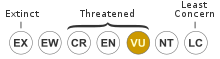
The hyacinth macaw ( Anodorhynchus hyacinthinus ), or hyacinthine macaw, is a parrot native to central and eastern Southward America. With a length (from the top of its head to the tip of its long pointed tail) of most one meter it is longer than whatever other species of parrot. It is the largest macaw and the largest flying parrot species; the flightless kākāpō of New Zealand outweighs information technology at up to iii.five kg. While generally easily recognized, it could exist confused with the smaller Lear's macaw. Habitat loss and the trapping of wild birds for the pet merchandise have taken a heavy toll on their population in the wild, so the species is classified as Vulnerable on the International Matrimony for Conservation of Nature's Red Listing,[ane] and it is protected by its listing on Appendix I of the Convention on International Merchandise in Endangered Species of Wild animals and Flora (CITES).
Taxonomy [edit]
English physician, ornithologist, and artist John Latham first described the hyacinth macaw in 1790 under the binomial name Psittacus hyacinthinus.[iii] Tony Pittman in 2000 hypothesized that although the illustration in this work appears to be of an actual hyacinthine macaw, Latham's description of the length of the bird might hateful he had measured a specimen of Lear'southward macaw instead.[four] Nevertheless, Latham's description was based on a taxidermic specimen, which was the simply one Latham knew to be up until 1822. It was prepared from a living creature originally belonging to Lord Orford, and given to the land amanuensis Parkinson for display in the Leverian Museum later on it died.[5] [vi]
Nonetheless, Latham mentions another bird, which he calls the 'blue maccaw', supposedly the same size.[five] [6] This blue macaw was already described in Latham's 1781 volume of his A full general synopsis of birds as merely a variety of the blue and yellow macaw,[7] and was previously figured in the piece of work of Mathurin Jacques Brisson (1760),[8] Patrick Browne (1756)[ix] and Eleazar Albin (1738)[x] equally a macaw found in Jamaica.[7] Albin, Browne and Brisson all reference even older authors and country the bird likewise occurs on the mainland,[8] [9] [10] and Albin states this bird is the female version of the ruddy macaw.[10] Latham mentions that the provenance of parrots in general was oftentimes confused by the fact that the birds were much traded beyond the world for the purposes of sale.[7]
Information technology is one of two extant and one probably extinct species of the South American macaw genus Anodorhynchus.
Clarification [edit]
The largest parrot by length in the world, the hyacinth macaw is ane m (3 ft three in) long from the tip of its tail to the top of its head and weighs 1.2–ane.7 kg (2 lb ten oz – iii lb 12 oz).[xi] [12] Each wing is 38.8–42.5 cm (xv+ 1⁄4 –16+ three⁄4 in) long.[xi] The tail is long and pointed.[xi] Its feathers are entirely blueish, lighter above. Even so, the neck feathers can sometimes be slightly grayness. The ring effectually the parrots optics and surface area but underneath the beak are a potent, vibrant yellow.
-

Close-up of head
-

in flying in the Pantanal
-

on a stamp
Environmental [edit]
A main predator is the toco toucan, which consumes a large pct of the eggs.[13] Eggs are also regularly preyed on by corvids such equally jays and crows,[13] [14] opossums,[13] skunks[14] and coatis.[13] [14] The young are parasitized by larvae of flies of the genus Philornis.[15]
Behaviour [edit]
Food and feeding [edit]

A hyacinth macaw eating a nut at Pantanal in Brazil
The majority of the hyacinth macaw nutrition is equanimous of the nuts from specific palm species, such equally acuri and bocaiuva palms.[16] They have very stiff beaks for eating the kernels of hard nuts and seeds. Their strong beaks are even able to crevice coconuts, the large brazil nut pods, and macadamia nuts. The birds also boast dry out, smoothen tongues with a os within them that makes them an effective tool for tapping into fruits.[17] The acuri nut is so hard, the parrots cannot feed on it until it has passed through the digestive system of cattle.[16] In addition, they eat fruits and other vegetable matter. The hyacinth macaw more often than not eats fruits, nuts, nectar, and various kinds of seeds. Also, they travel for the ripest of foods over a vast surface area.[18]
In the Pantanal, hyacinth macaws feed almost exclusively on the nuts of Acrocomia aculeata and Attalea phalerata palm trees. This behaviour was recorded past the English naturalist Henry Walter Bates in his 1863 book The Naturalist on the River Amazons, where he wrote that
It flies in pairs, and feeds on the hard nuts of several palms, but especially of the Mucuja (Acrocomia lasiospatha). These nuts, which are then hard as to be difficult to break with a heavy hammer, are crushed to a lurid by the powerful bill of this macaw.
—Bates[19]
Charles Darwin remarked on Bates's account of the species, calling information technology a "splendid bird" with its "enormous beak" able to feed on these palm basics.[20]
In captivity, the palm nuts native to the hyacinth macaw's natural habitat are often not readily bachelor. In these circumstances the macadamia nut (which is native to Australia) is a suitable, nutritious and readily-accustomed alternative.[21] Coincidentally, the hyacinth macaw is one of the merely birds with the necessary jaw strength to open the nut, which requires 300psi of pressure to crack the beat out.[22]
Tool utilize [edit]
Limited tool employ has been observed in both wild and captive hyacinth macaws. Reported sightings of tool use in wild parrots get every bit far dorsum every bit 1863. Examples of tool apply that take been observed usually involve a chewed leafage or pieces of wood. Macaws often incorporate these items when feeding on harder nuts. Their use allows the nuts the macaws eat to remain in position (prevent slipping) while they gnaw into it. It is non known whether this is learned social behavior or an innate trait, but observation on convict macaws shows that hand-raised macaws exhibit this behavior, besides. Comparisons evidence that older macaws were able to open seeds more efficiently.[23]
Reproduction [edit]

Nesting takes place between July and December, with nests constructed in tree cavities or cliff faces depending on the habitat.[24] In the Pantanal region, xc% of nests are synthetic in the manduvi tree (Sterculia apetala). The hyacinth macaw depends on the toucan for its livelihood. The toucan contributes largely to seed dispersal of the manduvi tree that the macaw needs for reproduction.[25] However, the toucan is responsible for dispersing 83 % of the seeds of Sterculia apetala, only besides consumes 53% of eggs preyed.[24] Hollows of sufficient size are but found in trees around lx years of historic period or older, and contest is fierce.[25] Existing holes are enlarged and and so partially filled with woods chips.[26] The clutch size is one or two eggs,[16] although usually merely i fledgling survives[16] as the second egg hatches several days afterwards the kickoff, and the smaller fledgling cannot compete with the firstborn for food. A possible explanation for this behaviour is what is called the insurance hypothesis. The macaw lays more eggs than tin can be normally fledged to compensate for before eggs that failed to hatch or firstborn chicks that did not survive.[27] The incubation period lasts about a month, and the male person tends to his mate whilst she incubates the eggs.[16] The chicks exit the nest, or fledge, around 110 days of age,[15] and remain dependent on their parents until six months of age.[16] They are mature and begin breeding at seven years of age.
General traits [edit]
Hyacinth macaws are the longest psittacine. They are as well very fifty-fifty-tempered and can be calmer than other macaws, beingness known as "gentle giants".[28] An attending veterinarian must be enlightened of specific nutritional needs and pharmacologic sensitivities when dealing with them. Possibly due to genetic factors or convict rearing limitations, this species can become neurotic/phobic, which is problematic.[29]
Distribution and habitat [edit]
The hyacinth macaw occurs today in three principal areas in South America: In the Pantanal region of Brazil, and adjacent eastern Bolivia and northeastern Paraguay, in the cerrado regions of the eastern interior of Brazil (Maranhão, Piauí, Bahia, Tocantins, Goiás, Mato Grosso, Mato Grosso do Sul, and Minas Gerais), and in the relatively open areas associated with the Tocantins River, Xingu River, Tapajós River, and the Marajó isle in the eastern Amazon Bowl of Brazil. Smaller, fragmented populations may occur in other areas.[24]
Over the final few decades the known range in Bolivia has grown. It is well known from the far southeast of the state near the tri-national edge point with Brazil and Paraguay, where it is considered an emblematic symbol of the region,[30] [31] and locals often feed the macaws maize, like chickens.[31] In the early on 1990s it became apparent the species also occurred in the remote Noel Kempff Mercado National Park area a few hundred kilometres northward.[14] Most of the Bolivian population of this macaw is thought to be constitute in the San Matías Integrated Management Natural Area, an area with extensive pantanal (swamp).[31] [32] Censuses conducted within in 2008, 2009, 2011[32] and 2014,[33] revealed stable population numbers: respectively 231, 107, 134,[32] and 166.[33] Bird counts in such a swampy and difficult to navigate terrain are inherently inadequate. The censuses were performed past visiting locations with previous reported sightings, nevertheless, information technology was non always possible to visit all sites, coverage varied. Thus in 2011 the earlier estimated population of near 300 birds in this surface area was considered to be largely accurate.[32] A 2014 study which correlated sightings to habitat and extrapolated this over a larger area found the birds occur in the northern part of the Natural Area, and a like population likely also occurs in an as sized expanse to the due north of this, outside of the Natural Expanse.[33] In a 2018 Mongabay Latam article, park rangers relate that at that place is anecdotal evidence the population was increasing and spreading, as more sightings were being reported by local inhabitants and the bird was now confirmed for the first fourth dimension in a number of adjacent municipalities.[31]
The hyacinth macaw has escaped or been deliberately released in to Florida, USA, but there is no evidence that the population is breeding and may only persist due to standing releases or escapes.[34]
It prefers semi-open, somewhat wooded habitats. It normally avoids dense, boiling wood, and in regions dominated by such habitats, it is mostly restricted to the border or relatively open sections (e.g. along major rivers). In dissimilar areas of their range, these parrots are found in savannah grasslands, in dry out thorn forest known as caatinga, and in palm stands or swamps,[24] particularly the moriche palm (Mauritia flexuosa).[35]
A 2014 Bolivian study in San Matías Integrated Management Natural Expanse which correlated sightings to habitat plant that areas including seasonally inundated savannas, wetlands and anthropogenic areas habitats interspersed with a mosaic of savannas, were the all-time indicators for the presence of the macaws. The virtually preferred habitat past far was anthropogenic, which are primarily cattle ranches practising extensive grazing in this area. The authors, however, were not very impressed by these results, and cautioned the methodology might be flawed.[33]
Conservation and threats [edit]

The conservation status of the hyacinth macaw is assessed every bit vulnerable.[1] The first proper estimate of its total wild population was published by Munn in 1987 every bit iii,000 individuals, with a range of 2,500 to 5,000. Yamashita estimated the total earth captive population every bit equal or slightly more that in 1988.[14] An anonymous blogger associated with the NGO the World Wildlife Fund claimed in 2004 that an estimated 10,000 birds were taken from the wild in the 1980s, of which half were destined for the Brazilian market place, and that the wild population had increased to 6,500.[24] [36]
The hyacinth macaw is protected past law in Brazil and Bolivia,[24] and commercial export of wild sourced specimens is banned by its list on Appendix I of the CITES.[2] A number of long-term studies and conservation initiatives are in place; the Hyacinth Macaw Projection in the Brazilian country of Mato Grosso do Sul has carried out important research past ringing individual birds, and has created a number of artificial nests to compensate for the small number of sites available in the region.[xvi]
The Minnesota Zoo with BioBrasil and the World Wildlife Fund are involved in hyacinth macaw conservation.[26] [37]
Threats [edit]
Throughout the macaw's range, habitat is existence lost or contradistinct due to the introduction of cattle ranching and mechanised agriculture, and the development of hydroelectric schemes.[24] Almanac grass fires set past farmers can destroy nest copse, and regions previously inhabited by this macaw are at present unsuitable likewise due to agriculture and plantations. Locally, information technology has been hunted for food, and the Kayapo Indians of Gorotire in south-primal Brazil apply its feathers to make headdresses and other ornaments. While overall profoundly reduced in numbers, it remains locally common in the Brazilian Pantanal, where many ranch-owners now protect the macaws on their land.[38]
Parrots as a whole, beingness of the family Psittacidae, are some of the most threatened birds in the world. This family unit has the most endangered species of all bird families, specially in the neotropics, the natural habitation of the hyacinth macaw, where 46 of 145 species are at a serious chance of global extinction.[39] This species qualifies equally 'Vulnerable' on the IUCN Red Listing because the population has suffered rapid reductions with the remaining threats of illegal trapping for the cage bird merchandise and habitat loss[40] A few serious threats to the survival of the species in the Pantanal include human activities, mainly those resulting in habitat loss, the burning of state for pasture maintenance, and illegal trapping[41] The exceptionally noisy, fearless, curious, sedentary, and predictable nature of this species, along with its specialization to only one or two species of palm in each part of its range, makes them particularly vulnerable to capture, shooting, and habitat destruction.[42]
Although the species has a low genetic variability, information technology does not necessarily pose a threat to their survival. This genetic structure accentuates the need for protection of hyacinth macaws from unlike regions to maintain their genetic variety. Nevertheless, the about of import factors negatively affecting the wild population evidence to be habitat devastation and nest poaching.[43]
In the Pantanal, habitat loss is largely contributed to the creations of pastures for cattle, while in many other regions, it is the result of clearing country for colonization.[44] Similarly, large areas of habitat in Amazonia accept been lost for cattle ranching and hydroelectric power schemes on the Tocantins and Xingu Rivers. Many immature manduvi copse are and so being grazed on past cattle or burnt past burn, and the Gerias is chop-chop being converted to country for mechanized agriculture, cattle ranching, and exotic tree plantations.[ane] Almanac grass fires gear up by farmers destroy a number of nest trees, and the rising of agriculture and plantations has made habitats formerly populated by the macaws unsuitable to maintain their livelihoods.[twoscore] Moreover, increase in commercial demand for feather art by the Kayapo Indians threatens the species, as upwards to x macaws are needed to make a single headdress.[42]
In the consequence of the macaws existence taken from their natural surround, a diverseness of factors alter their health such as inadequate hygiene conditions, feeding, and overpopulation during the illegal practise of pet trade. Once birds are captured and brought into captivity, their mortality rates can become very high.[44] Records reveal a Paraguayan dealer receiving 300 unfeathered young in 1972, with all only iii non surviving. Due to the poor survival rates of the young, poachers concentrate more heavily on adult birds, which depletes the population at a rapid pace.[42]
According to Article 111 of Bolivian Environmental Police force #1333, all persons involved in the trade, capture, and transportation without authority of wild animals will suffer a two-year prison sentence, along with a fine equivalent to 100% of the value of the animal.[45] While many trackers have been arrested, the illegal pet trade yet largely continues in Santa Cruz, Bolivia. Unfortunately, animal trafficking is non necessarily viewed as a priority in the metropolis, leaving national departmental and municipal governments unwilling to halt the merchandise in city centers, and local law reluctant to get involved. This ideology has in turn resulted in a lack of enforcement regarding trade in both CITES-restricted species and threatened species, with trivial to no restrictions regarding humane treatment of the animals, illness control, or proper hygiene. In the merchandise centers, the hyacinth macaw demanded the highest toll of US$one,000, proving it to be a very desirable and valued bird in the pet trade industry.[46]
Conservation steps taken to preserve the hyacinth macaw [edit]
In 1989, the European Endangered Species Programme for the hyacinth macaw was founded equally a issue of concerns about the status of the wild population and the lack of successful breeding in captivity.[45] Convenance in captivity nonetheless remains difficult, existence that hand-reared hyacinth macaw offspring take demonstrated to have college bloodshed rates, peculiarly within the beginning calendar month of life. Additionally, they have a college incidence of astute crop stasis than other macaw species due, in office, to their specific dietary requirements.[47] The hyacinth macaw is protected by police force in Brazil and Republic of bolivia, and international trade is prohibited by its list on Appendix I of the CITES.[40] Appendix I has banned exporting the bird in all countries of origin, and several studies and conservational initiatives have been taken.[1] The Hyacinth Macaw Project in the Caiman Ecological Refuge, located in the Pantanal, has employed bogus nests and chick management techniques, forth with effectively raising awareness among cattle ranchers. Many ranch owners in the Pantanal and Gerais, to protect the birds, no longer let trappers on their properties.[one]
A number of conservation actions have been proposed, including the study of the electric current range, population status, and extent of trading in dissimilar parts of its range. Additionally, propositions have been made to assess the effectiveness of artificial nest boxes, enforce legal measures preventing trade, and experiment with ecotourism at one or two sites to encourage donors.[1] Furthermore, the Hyacinth Macaw Project in Mato Grosso do Sul has carried out important inquiry by ringing individual birds and has created a number of artificial nests to compensate for the small number of sites available in the region.[40] Furthermore, proposals to list the species as Endangered nether the U.Southward. Endangered Species Human action have been fabricated to farther protective measures in the U.s. and to create Bolivian and Paraguayan trade management government nether presidential control.[42]
Long-term prospects [edit]
Each of the iii principal populations should be managed every bit a separate biological entity so as to avoid numbers dropping below 500. While the birds may be in decline in the wild, notably higher populations of captive macaws are being held in zoos and private collections. If success in managing and replanting the macaw'due south food trees and erecting nest boxes every bit an experiment in the Pantanals is seen, the species could survive. Survival rates could also be enhanced if ranch owners would exit all large and potential nest trees standing and eliminate all trapping on their backdrop. Ultimately, should these factors work in tandem with erection of nest boxes, fencing off of certain saplings, and the planting of others, the long-term prospects of the hyacinth macaw species would be greatly improved.[42]
Aviculture [edit]
The hyacinth macaw is sometimes kept equally a companion parrot. Not recommended for novice bird-keepers, this bird requires big amounts of space, regular exercise and a custom-congenital stainless steel muzzle, as its powerful beak can easily destroy about commercially bachelor parrot cages. In gild to remain healthy, the species requires regular social interaction and play with humans or other birds. This large macaw, like well-nigh parrots has a natural inclination to chew objects and due to its physical size and forcefulness, can cause considerable damage. Information technology is recommended that an entire room of the owner'southward abode is set aside for use by the bird, which should be provided with plenty of safe, destroyable wooden and leather objects to keep it amused. Information technology is also a very expensive pet: US$x,000 is not an uncommon price for a young hyacinth macaw.[48] [49] [50] The Earth Parrot Trust recommends that the hyacinth macaw should non be kept permanently indoors and that information technology should have access to an enclosure of at least 15m (50 ft) for part of the year.[49]
This bird is ofttimes described as "gentle". It is non generally an ambitious bird and information technology appears to enjoy interacting playfully with humans. It tin crusade bite injuries simply from playfully "mouthing" its possessor, nevertheless, and this beliefs should exist discouraged with grooming begun when the bird is young.[48]
The hyacinth macaw can learn to talk, but it is non as gifted in that area as some other species. Nonetheless, information technology is an intelligent bird that may learn to use words and phrases in the correct context.[28] Information technology can alive for over 50 years in captivity.[49]
See also [edit]
- Listing of macaws
References [edit]
- ^ a b c d east f one thousand BirdLife International. (2016) Anodorhynchus hyacinthinus. The IUCN Red List of Threatened Species 2016. doi:10.2305/IUCN.United kingdom.2016-3.RLTS.T22685516A93077457.en
- ^ a b "Appendices | CITES". cites.org . Retrieved 14 Jan 2022.
- ^ Latham, John (1790). Index Ornithologicus, Sive Systema Ornithologiae: Complectens Avium Divisionem in Classes, Ordines, Genera, Species, Ipsarumque Varietates (in Latin). Vol. ane. London: Sumptibus authoris (prostant venales apud Leigh & Sotheby). p. 84. doi:10.5962/bhl.championship.131313.
- ^ Pittman, Tony (2000). "The Lear'southward Macaw". Parrots - Parrot Conservation - Convenance. The Parrot Gild UK. Retrieved 8 October 2021.
- ^ a b Latham, John (1802). Supplement II to the General synopsis of birds. London: Leigh, Sotheby, & Son. p. eighty & 81. doi:10.5962/bhl.championship.49008.
- ^ a b Latham, John (1822). A general history of birds. Vol. II. Winchester: Printed by Jacob and Johnson, for the author. p. 109. doi:10.5962/bhl.title.62572.
- ^ a b c Latham, John (1781). A full general synopsis of birds. Vol. 1, part 1. London: Benj. White. p. 198, 204 & 205. doi:ten.5962/bhl.title.49894.
- ^ a b Brisson, Mathurin Jacques (1760). Ornithologia, sive Synopsis methodica sistens avium divisionem in ordines, sectiones, genera, species, ipsarumque varietates (in French and Latin). Vol. IV. Paris: Advertising Ripam Augustinorum, apud Cl. Joannem-Baptistam Bauche, bibliopolam, advertizing Insigne S. Genovesae, & Due south. Joannis in Deserto. p. 192 & 193. doi:10.5962/bhl.title.51902.
- ^ a b Browne, Patrick (1756). The civil and natural history of Jamaica : in 3 parts. London: Printed for the author, and sold by T. Osborne and J. Shipton. p. 472. doi:10.5962/bhl.title.10826.
- ^ a b c Albin, Eleazar (1738). Derham, William (ed.). A natural history of birds : illustrated with a hundred and ane copper plates, engraven from the life. Vol. Iii. London: Printed for the writer and sold by William Innys. p. 10. doi:ten.5962/bhl.championship.62897.
- ^ a b c Forshaw (2006). plate 70.
- ^ Hagan, E. (2004). Anodorhynchus hyacinthinus. Animal Diverseness Spider web.
- ^ a b c d Predator of the world'southward largest macaw fundamental to its survival Archived 4 June 2009 at the Wayback Motorcar. news.mongabay.com (2008-03-xiii).
- ^ a b c d e Collar, N.J.; Gonzaga, L.P.; Krabbe, N.; Madroño Nieto, A.; Naranjo, 50.G.; Parker, T.A., III; Wege, D.C. (1992). "Hyacinth Macaw Anodorhynchus hyacinthinus" (PDF). Threatened Birds of the Americas. Washington DC: Smithsonian Institution Printing. p. ane-9.
- ^ a b Allgayer, M. C.; Guedes, North. K. R.; Chiminazzo, C.; Cziulik, M.; Weimer, T. A. (2009). "Clinical Pathology and Parasitologic Evaluation of Free Living Nestlings of the Hyacinth Macaw (Anodorhynchus hyacinthinus)". Journal of Wild fauna Diseases. 45 (four): 972–81. doi:10.7589/0090-3558-45.4.972. PMID 19901373.
- ^ a b c d e f grand "Hyacinth Macaw". WWF. Archived from the original on four November 2002. Retrieved 19 September 2013.
- ^ "Macaw Psittacidae". National Geographic. 11 Nov 2010. Retrieved 24 Oct 2013.
- ^ "The Existent Macaw Endangered Tropical Jewels". Public Broadcasting Service. 26 February 2004. Retrieved 23 December 2014.
- ^ Bates, Henry Walter (1863). The naturalist on the River Amazons, Volume 1. Vol. ane. London: John Murray. p. 133.
- ^ Darwin, Charles (1863). "An Appreciation: The Naturalist on the River Amazons by Henry Walter Bates". Natural History Review, vol iii. Archived from the original on 7 June 2011. Retrieved 27 March 2013.
- ^ "The Hyacinth Macaw".
- ^ "Imponderables: Macadamia Nuts".
- ^ Borsari, Andressa; Ottoni, Eduardo B. (2004). "Preliminary observations of tool utilize in captive hyacinth macaws (Anodorhynchus hyacinthinus)". Animal Cognition. 8 (1): 48–52. doi:10.1007/s10071-004-0221-3. PMID 15248094. S2CID 200601.
- ^ a b c d e f g "Hyacinth Macaw (Anodorhynchus hyacinthinus): BirdLife species factsheet". BirdLife International. Archived from the original on 22 June 2011. Retrieved xix September 2013. – via ARKive
- ^ a b Pizo, Marco A.; Donatti, Camila I.; Guedes, Neiva R.; Galetti, Mauro (2008). "Conservation Puzzle: Endangered Hyacinth Macaw Depends on Its Nest Predator for Reproduction" (PDF). Biological Conservation. 141 (three): 792–96. doi:ten.1016/j.biocon.2007.12.023. Retrieved 23 October 2013.
- ^ a b Brouwer, Meindert (21 Apr 2004). "The hyacinth macaw makes a comeback". WWF. Retrieved 20 July 2011.
- ^ Kuniy, A. (2006). "Handling technique to increase the hyacinth macaw population (Anodorhynchus hyacinthinus) (Lalham, 1720) – Written report of an experience in Pantanal, Brazil". Brazilian Journal of Biological science. 66 (1B): 381–82. doi:x.1590/S1519-69842006000200021. PMID 16710531.
- ^ a b Kalhagen, Alyson. "Hyacinth Macaws". Pet Birds. Nigh.com. Retrieved 28 Oct 2013.
- ^ Lennox, Angela. "The companion bird" (PDF). Clinical Avian Medicine, Volume 1. p. 35.
- ^ "Área Natural de Manejo Integrado San Matías" (in Spanish). Servicio Nacional de Áreas Protegidas, Government of Bolivia. 2018. Retrieved 31 October 2021.
- ^ a b c d Franco Berton, Eduardo (16 May 2018). "Paraba azul: ¿podrá salvarse la población de esta ave emblemática de Bolivia?". Mongabay Latam (in Spanish). Environmental News. Retrieved 31 October 2021.
- ^ a b c d Pinto-Ledezma, Jesús N.; Sosa, Ronald; Paredes, Maya; García, Ivan; Villarroel Segarra, Daniel; Muyucundo, Steven; Rivero Mamani, Mary Laura (June 2011). "La Paraba Jacinta (Anodorhynchus hyacinthinus): Estado Poblacional y su Conservación en el Pantanal Boliviano" [The Hyacinth Macaw (Anodorhynchus hyacinthinus): Population Status and its Conservation in Bolivian Pantanal] (PDF). Kempffiana (in Castilian). 7 (1): 19–31. Retrieved 31 October 2021.
- ^ a b c d Pinto-Ledezma, Jesús N.; Sandoval, 10. Vanessa; Pérez, Valkiria Due north.; Caballero, Thania J.; Mano, Katherine; Pinto Viveros, Marco A.; Sosa, Ronald (September 2014). "Desarrollo de un modelo espacial explícito de hábitat para la paraba jacinta (Anodorhynchus hyacinthinus) en el Pantanal boliviano (Santa Cruz, Bolivia)" [A spatial explicit habitat model for the Hyacinth Macaw (Anodorhynchus hyacintinus) in the Bolivian Pantanal (Santa Cruz, Bolivia)]. Ecología en Bolivia (in Spanish). 49 (2). Retrieved 31 Oct 2021.
- ^ "Nonnatives - Hyacinth Macaw". Archived from the original on ane June 2011.
- ^ Forshaw, Joseph M. (2006). Parrots of the Earth; an Identification Guide . Illustrated past Frank Knight. Princeton University Printing. p. 95. ISBN978-0-691-09251-5.
- ^ "The hyacinth macaw makes a comeback". panda.org. World Wildlife Fund. 21 Apr 2004. Retrieved 22 October 2021.
- ^ "BioBrasil and the Minnesota Zoo working to save Hyacinth Macaws". Minnesota Zoo. Retrieved 19 September 2013.
- ^ "Hyacinth macaw (Anodorhynchus hyacinthinus)". arkive.org. Archived from the original on 5 September 2015. Retrieved xi August 2015.
- ^ Wright, Timothy F.; Toft, Catherine A.; Enkerlin-Hoeflich, Ernesto; Gonzalez-Elizondo, Jaime; Albornoz, Mariana; Rodríguez-Ferraro, Adriana; Rojas-Suárez, Franklin; Sanz, Virginia; Trujillo, Ana; Biessinger, Steven R.; Berovidas A., Vincente (June 2001). "Nest Poaching in Neotropical Parrots" (PDF). Conservation Biology. 15 (3): 710–720. doi:x.1046/j.1523-1739.2001.015003710.x. S2CID 13256101.
- ^ a b c d Anodorhynchus hyacinthinus: Hyacinth Macaw. 2013. Encyclopedia of Life.
- ^ Pinho, J. B. & Nogueira, Flavia M. B. (2003). "Hyacinth Macaw (Anodorhynchus hyacinthinus) reproduction in the northern Pantanal, Mato Grosso, Brazil". Ornitologia Neotropical. 14: 29–38.
- ^ a b c d e Collar, Northward. J. & Juniper, A. T. Dimensions and Causes of the Parrot Conservation Crisis (PDF). International Council for Bird Preservation. pp. i–6, 9, 12–15, 19.
- ^ Faria, Patrícia J.; Guedes, Neiva One thousand. R.; Yamashita, Carlos; Martuscelli, Paulo; Miyaki, Cristina Y. (2008). "Genetic variation and population structure of the endangered Hyacinth Macaw (Anodorhynchus hyacinthinus): implications for conservation". Biodiversity and Conservation. 17 (4): 765. doi:10.1007/s10531-007-9312-1. S2CID 22639692.
- ^ a b Tania F. R; Glaucia H. F. R.; Nevia M. R. M.; Aramis A. Thou. (2006). "Chlamydophila psittaci in free-living Blue-fronted Amazon parrots (Amazona aestiva) and Hyacinth macaws (Anodorhynchus hyacinthinus) in the Pantanal of Mato Grosso do Sul, Brazil". Veterinary Microbiology. 117 (2–4): 235–41. doi:10.1016/j.vetmic.2006.06.025. PMID 16893616.
- ^ a b Lücker, H. & Patzwahl, South. (2000). "The European Endangered Species Programme (EEP) for the Hyacinth macaw Anodorhynchus hyacinthinus from 1989 to 1998". International Zoo Yearbook. 37: 178–183. doi:10.1111/j.1748-1090.2000.tb00720.x.
- ^ Mauricio, H. & Hennessey, B. (2007). "Quantifying the illegal parrot trade in Santa Cruz de la Sierra, Bolivia, with accent on threatened species". Bird Conservation International. 17 (4): 295–300. doi:x.1017/S0959270907000858.
- ^ Casares, M.; F. Enders (1998). "Experiences in the manus-rearing of hyacinth macaws (Anodorhynchus hyacinthinus) in Loro Parque". Zoologische Garten. 68: 65–74.
- ^ a b "Hyacinth Macaw Personality, Food & Care & Pet Birds by Lafeber Co". Retrieved 23 December 2020.
- ^ a b c "Hyacinth Macaw (Anodorhynchus hyacinthinus) | Parrot Encyclopedia". Globe Parrot Trust. Retrieved 23 December 2020.
- ^ Kalhagen, Alyson. "How to Care for Hyacinth Macaws (Blue Parrots)". The Spruce Pets . Retrieved 23 Dec 2020.
External links [edit]

- Hyacinth macaw on the Internet Bird Collection
- Hyacinth macaw media from ARKive
- The Bluish Macaws website
- In-Depth Blue Macaw Inquiry
- Audio File of the hyacinth macaw


6 Ft 3 In Centimeters,
Source: https://en.wikipedia.org/wiki/Hyacinth_macaw
Posted by: eilermansuppen.blogspot.com
0 Response to "6 Ft 3 In Centimeters"
Post a Comment