

How To Plant Wildflowers On A Steep Slope
Why Plant Wildflowers?
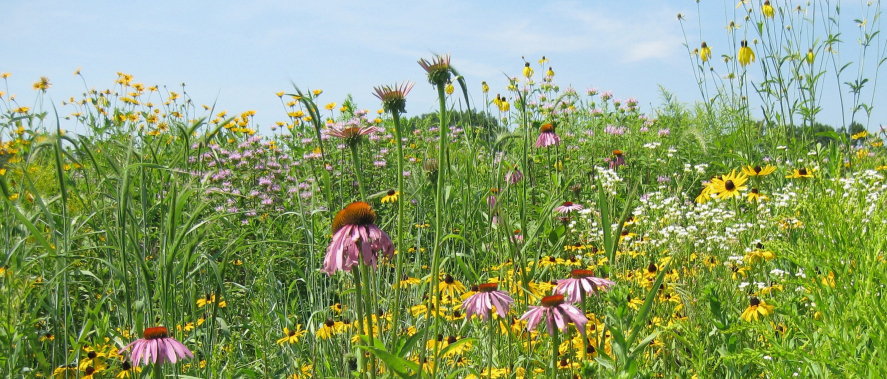
Native bees and other pollinators are essential to the successful product of many fruit and vegetable crops and the reproduction of many constitute species in our surrounding surroundings. Wildflower meadows and gardens are extremely valuable habitat, providing floral resources, nesting sites and a protected environment for hundreds of bee species, moths and butterflies, and other insects. Many birds, bats, minor mammals and some amphibians besides thrive on the food and shelter that a meadow ecosystem provides.
Meadows provide many of import ecosystem services including infiltration and filtration of stormwater, carbon storage, nutrient recycling, soil edifice, and provisioning of food and shelter for biodiverse communities of flora and beast. Past establishing native perennials and grasses in a dumbo and diverse meadow planting, property owners can bask the beauty of a succession of flowers and institute forms and feel a renewed connectedness with nature. Done properly, wildflower meadows are ecologically-friendly landscape components that, once established, accept minimal maintenance requirements.
Soil testing can provide you with useful information regarding pH and organic matter content, only wildflowers generally prefer depression fertility sites. Decide whether the soil tends to exist moisture or dry out, and if the site gets total sun, filtered sun or shade.
Choosing a Site
Not all wildflowers are suitable for all conditions. A site with total sunday and good drainage is ideal for many species, merely partial shade and/or wet areas can exist tolerated by many others. Consider your site and soil weather advisedly in order to select an appropriate wildflower mix.
It'south all-time to start in a pocket-sized area, only consider 400 square feet to be a minimal size for a wildflower meadow – this space can support a adept diversity of wildflower species. Some types of wildflowers get quite alpine and may tend to lean or flop, but they volition help hold each other up if planted densely in an surface area where they will not interfere with walkways or other mural features. A wildflower meadow is informal past nature, and tin exist a bit wild and untidy looking at certain times of the year, so locate it where it will be viewed from a distance of several meters or more. For a neater, more designed meadow expect, buy pocket-size transplants instead of starting from seed, and constitute in intentional groupings equally in a garden.
A identify where bees can come and go safely with little disturbance or exposure to pesticides or other household chemicals is platonic. Many native bees demand patches of bare soil nearby in which to brand their nests; others will nest in pocket-sized holes in dead wood or stems, in cavities in stone walls or in leaf litter or debris piles. These features are frequently found along the edges of fields or woodlands and should exist preserved. Some people build or purchase bee boxes or bee houses to encourage stonemason bees and other solitary bees to nest near their crops or gardens.

Seed Mixes and Species Pick
At that place are many wildflower mixes available from reputable seed companies1 , or you can design your own mix. Pre-made mixes may be user-friendly, but must be selected carefully to avoid paying for species that are unlikely to be successful in New England, or that might be overly aggressive. Less expensive mixes frequently contain a college proportion of grasses than desired for good pollinator habitat.
Knowing your site characteristics (wet, medium or dry out soil and total sunday, filtered sun, or shade, at a minimum) is essential to agreement which species will thrive on your site and create a mixed meadow that knits together in a mosaic of colors and textures.
An platonic meadow mix volition provide a continuous sequence of bloom from a dozen or more native perennial wildflowers (a.k.a. forbs). A few native warm-flavour grasses should be included to create habitat and shelter for many organisms, and to create dense cover that suppresses weed growth. Some mixes contain annuals, which volition give you firstseason color merely are by and large non native species and not sustainable over time. Yous are better off in the long term to spend your money on perennial species. Past including black-eyed Susan, and perchance dotted horsemint, you can nevertheless get some blooms the first season to satisfy the need for color and provide some flowers for bees.
A suggested wildflower mix for medium to dry out sites in full to partial sun is given in Table i. This list is equanimous of reliable species that accept performed well in research trials at the NH Agronomical Experiment Station in Durham and elsewhere around the state. Not every species will thrive (or even survive) on every site, but near are widely adjustable.
Seed mixes can be customized to encounter your objectives and budget. The cost for the seed mix in Table 1 volition run an average of $sixty-80 per 1000 square feet, if seeded at a rate of xx lbs per acre (0.v lbs/g foursquare anxiety). If budget is not a limiting factor, y'all might want to add seeds of native lupine and butterfly weed, both of which require very dry soils. If your site tends to be moisture, a more appropriate mix would contain cardinal flower, blue vervain, Culver'due south root, golden Alexanders, boneset, swamp milkweed and Joe-Pye weed.
Yous can either purchase seed packets and mix the seed yourself, or a wildflower seed company may mix information technology for you on request. Gild seed early in the summer to avoid shortages of popular mixes or species. Ask to accept the (large and fluffy) native grass seed packaged separately from the (more often than not tiny) wildflower seed. Store the wildflower seed in the refrigerator until planting time. The grass seed would ideally exist refrigerated too, but if there isn't room for information technology, keep information technology in another cool dry identify.
UNH custom mix of reliable species, suitable for sunny sites with medium to dry soils and a pH of 5.5 or above. Suggested seeding rate is 0.5 lbs per thousand square anxiety of area.
Wildflower Species, Common Names, Percentage of mix by weight
- Aguilegia canadensis, Cherry Columbine, 3%
- Asclepias syriaca, Common Milkweed, 3%
- Chamaecrista fasciculata, Partridge Pea, 8%
- Coreopsis lanceolata, Lanceleaf Coreopsis, 3%
- Echinacea purpurea, Purple Coneflower, 7%
- Echinacea pallida, Pale Imperial Coneflower, 11%
- Eutrochium purpureum,Purple Joe-Pye Weed, 1.v%
- Heliopsis helianthoides, Oxeye Sunflower, ii%
- Monarda fistulosa, Wild Bergamot, 0.l%
- Monarda punctata, Dotted Horsemint, 0.fifty%
- Oligoneuron rigidum, Stiff Goldenrod, 0.50%
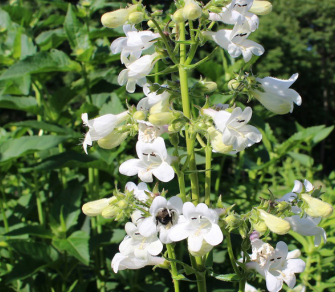
- Penstemon digitalis, Foxglove Beardtongue, ane.5%
- Ratibida pinnata, Yellow Coneflower, 3.5%
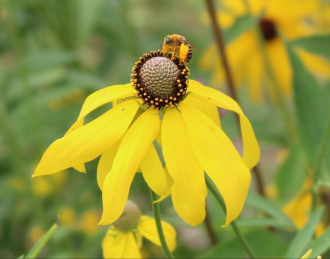
- Rudbeckia hirta, Blackness Eyed Susan, 2%
- Solidago speciosa, Showy Goldenrod, 1%
- Symphyotrichum novae-angliae, New England Aster, i%
- Symphyotrichum laeve, Shine Blue Aster, 2%
Grass Species, Common Names, Percentage of mix by weight
- Elymus canadensis, Canada Wild Rye, x%
- Shizachyrium scoparium, Footling Bluestem, thirty%
- Sorghastrum nutans, Indian Grass, 10%
Site Preparation
Successfully establishing a meadow from seed is a three-twelvemonth procedure, with the first year devoted to adept site preparation. This isn't the fun part but eliminating competitive weeds before you plant is essential to long-term success. How to get started depends on the showtime site conditions and what materials and methods you decide to use. The following methods have been developed based on research and demonstration plantings in New Hampshire and are advisable for the Northeast and other areas with similar climate patterns.
Smothering with black plastic excludes light from the underlying weeds, preventing photosynthesis which is essential for plants to survive over fourth dimension. Although black plastic absorbs some heat during the day, soil temperatures underneath do not get high enough for long plenty to impale weed seeds. Solarization, in contrast, acts past trapping solar radiations and converting it to heat underneath clear plastic sheeting. Farthermost temperatures for long durations can reduce viability of sensitive weed seeds, although the results are inconsistent in our climate.
What are Yous Starting with?
Crude turf or lawn expanses – It is essential to completely kill existing grasses and other perennial weeds in a turf expanse before planting wildflowers. A full season of site preparation is critical to success, because young wildflower seedlings stay small and depression to the ground their offset year of growth and are not able to compete against more vigorous weeds. Perennial grasses, such equally our cool season backyard and pasture grasses, spread from strong underground roots and rhizomes and are particularly troublesome when trying to establish wildflowers. These and other perennial weeds can be effectively killed by a process called "smothering" during the course of the summertime prior to planting wildflower seeds. Steps to accept:
- Mow the expanse equally short as possible once or twice subsequently it greens up in the spring. Scalp information technology! Then, rake off any excessive organic matter to create a smoothen surface. Leaving a low-cal layer of clippings is okay. Do not till the soil.
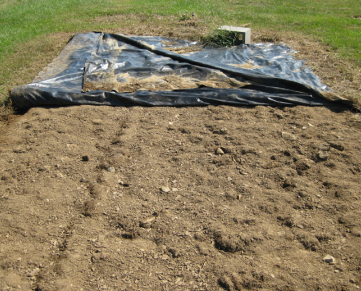
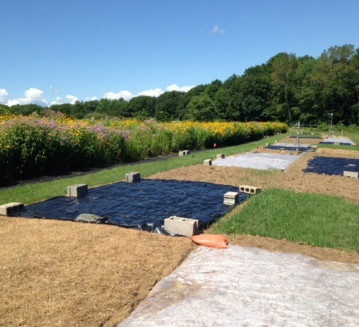
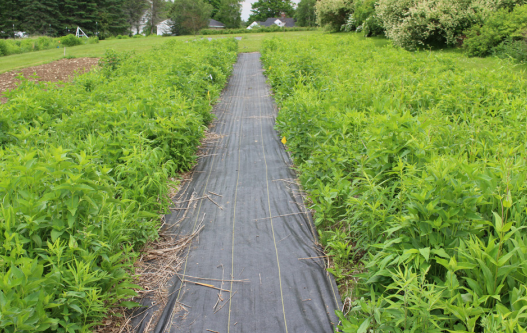
- Lay sheets of thick (4- or half dozen-mil) black plastic over the entire area, overlapping the edges by near a pes if you apply more than one sheet or coil of plastic. Bury all the outside edges with soil, and/or hold the plastic downward with rocks, cinderblocks, bricks or other bachelor materials. The objective is to exclude lite from the grass and weeds trying to grow nether the plastic. Weeds without lite are unable to photosynthesize and will eventually run out of free energy and die. Whatever seeds that germinate nether the plastic are likewise unable to survive for long.
Opaque tarps, mural cloth, or thick layers of organic mulch tin be used in place of black plastic if desired. If you prefer to use an organic mulch, it'southward all-time to start with a layer of paper-thin so that grass and weeds cannot grow up through the mulching cloth. Watering the cardboard and pinning it downwards may assistance information technology stay in place. Applying shredded bawl, leaves or other material over the top may make information technology less conspicuous than an expanse of plastic or cardboard. However, all the organic material should exist raked off and redistributed elsewhere before seeding, to avert enriching nutrient levels in the soil.
- Leave the soil covered from mid-June until mid-September. When you remove the plastic or other mulch materials, yous volition have bare soil on which to plant. Avoid disturbing this clean seed bed; do not till the prepared area or you may stimulate more than weed growth. Practice not employ compost, manure or other nitrogen-rich fabric, because wildflowers do best in soil that is depression in nutrients. If needed, rake lightly to remove dead grasses and surface debris simply earlier spreading the wildflower seed.
Smothering is an easy, cheap, no-till method for preparing small to medium size areas. Alternatively, in turf areas you could remove the top layer of sod with a sod cutter and then apply i of the site grooming methods described for cultivated soil, below
Use herbicides with circumspection. Follow all label instructions including the utilize of protective clothing. Do not spray when weeds are in bloom or bees are present.
Cultivated soil (such equally an agricultural field or garden) – A piece of land that has been recently cultivated for crops may appear to be relatively weed-free; nevertheless, at that place is normally a reserve banking company of weed seeds lying dormant in the soil. Eliminating seedlings every bit they announced (and before they set seed) will diminish the weed seed bank over fourth dimension.
4 options for reducing the weed seed bank are presented beneath. Whatever of these strategies should be implemented for the entire growing flavour prior to planting the meadow mix. The starting time two methods tend to be most constructive for annuals and some perennials reproducing from seeds, merely are less effective where perennial grasses are already well-established; if that is the case, use of herbicides or the smothering method described above is more constructive.
- Repeated tillage or tillage. If weed pressure is low, manually pulling or hoeing to kill germinating seedlings may be sufficient, just for big areas and/or heavy weed pressure level, a mechanical cultivator is recommended. If perennial grasses or deep rooted weeds are nowadays, the surface area should be tilled securely starting time, so shallower cultivations used afterward. Cultivating at a shallow depth should suppress germinating annuals and some broadleaf perennials simply is less effective on clover and grasses, peculiarly those coming dorsum from root pieces or rhizomes. Repeat the operation whenever a affluent of weeds appears.
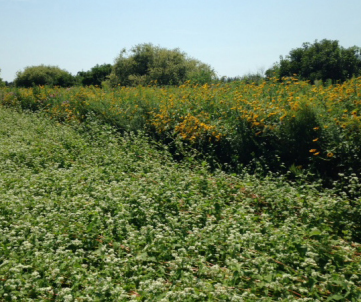
- Cover crops. Planting a dumbo summer cover crop will suppress weeds by shading and competing for infinite. Buckwheat is a adept choice and volition blossom and provide floral resource for bees during the summertime. Mow or roll it at the end of the bloom period to forbid seed set; any live tissue remaining will be killed by freezing temperatures in fall. A late season ingather of oats is also a good pick, as oats will be killed by wintertime temperatures. Cover crop residue must decompose before seeding wildflowers, however, and so fall planting is not viable. Rake off droppings and smooth the soil surface before seeding the following leap, simply tilling is not recommended equally it will bring up more weed seeds.
- Herbicides. Two or three applications (early flavor, mid-season and perhaps early autumn) of a nonselective systemic herbicide is a highly effective method for killing actively-growing almanac and perennial weeds. There are culling "burn" and/or organic products which may be used, but these are not translocated in the plant to kill roots and rhizomes; therefore, more applications are needed to eliminate weeds every bit regrowth occurs and/or new seeds germinate throughout the growing flavour. Do non till the soil after using herbicides in order to avert bringing upwards more weed seeds.
- Solarization. This method involves covering bare, moist soil with clear (not white) plastic from mid-June through mid-September or longer. Effective solarization depends on trapping solar radiation as heat, raising the soil temperature high enough to kill weed seeds. Solarization is most reliable in hot, arid climates, only may yield some success if the site is fully exposed to sunday and the edges of the plastic are buried to effectively trap heat. Use four- or 6-mil UV resistant plastic, such every bit growers use to cover high tunnels or greenhouses. Used plastic is okay but will develop tears and holes more quickly from photo degradation or from animals such as deer walking across the surface. Use heavy-duty clear repair tape to seal up any tears and holes which occur as soon equally possible, or the openings will human activity every bit vents and make the solarization process less effective. There are alien reports on the effectiveness of soil solarization on weed suppression in northern climates and results may vary from year to year. In a cloudy, absurd season it is apt to be unsatisfactory.
Woods/woodland sites – recently logged or cleared woodlands ordinarily accept low soil pH and nutrient levels, just still can go successful meadow areas. Stumping, grading and/or excavating and raking is usually necessary. The period of fourth dimension between clearing and seeding may be bridged with an annual grass ingather or cover crops. Spotter to run into what weeds (or tree sprouts!) emerge during this fourth dimension and utilise herbicides and/ or mechanical controls as needed. Cover crops which are winter killed, such as oats or buckwheat, will help smother new weeds that come upward during the growing flavor, but essentially preclude fall planting, equally they must commencement decompose or be removed. It is best not to till, in order to forbid new weed seeds from beingness brought to the surface, as well as rocks and roots.
An effort should be made to select species that are tolerant of acrid soils. Yet, if pH is very depression (<5.5), it may be prudent to make an application of lime and other amendments every bit recommended by a soil test. Incorporation of amendments by tilling creates disturbance and may effect in loftier subsequent weed force per unit area, but may be needed to improve growth on poor, acid sites. Tilling may bring up roots, rocks and other items, requiring more raking and smoothing earlier seeding.
Other disturbed sites – structure sites or other sites which have been excavated, graded and/or filled with soil from off-site present a special challenge because conditions are hard to predict. Gathering as much information equally possible will help you select advisable meadow species for planting. Have the soil tested for soil texture, pH, nutrient levels, and organic matter. In one case the site work is washed, discover water movement and do a percolation test to check drainage. Using all this information, select a mix of species most suitable for the conditions.
To determine what the potential weed pressure is, observe what types of weeds come up upwardly over fourth dimension. To expedite this process, you tin fill up several plant nursery pots (or other large containers with drainage holes) with soil and water them regularly to see what weeds emerge. Based on your observations, determine whether there is a significant weed bank, in which case yous should proceed every bit if it was a previously vegetated area, or if weed competition is minimal and y'all tin can plant presently.
Planting – When and How
After a flavour of site preparation, yous are fix to establish! Remove plastic or other mulch materials and rake off any loose tree roots, leaves, cover ingather residues, etc. to prepare a make clean seed bed. Autumn is a good time to seed, equally wildflower formation will be enhanced by exposure to cold temperatures and damp soil during the winter. The fall planting season in northern New England extends from late September through early December, depending on the yr. A safe strategy is to aim for mid- to belatedly-October, whereas Nov conditions is unpredictable and snow could comprehend the ground at whatsoever time. If that happens, or if there are other reasons y'all cull to plant in the jump, store your seed in the refrigerator or other cold (35-40°F), dry place for the winter and and so constitute information technology as early in the spring as possible.
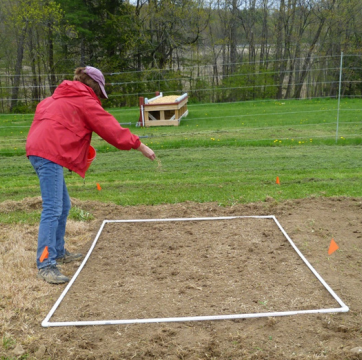
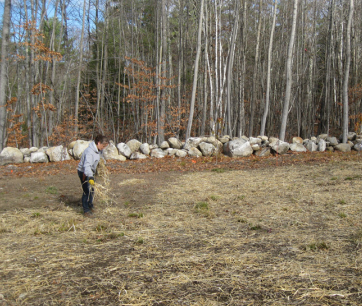
Dissemination (spreading seed by mitt) is the preferred method for small areas. A carrier such as vermiculite or sand is needed to "bulk up" the volume of fabric to be distributed
You might want to exercise distributing the moistened carrier without any seed at first, to exercise getting the right amount evenly distributed over the desired expanse. Use a broad sweeping throw for each handful, much like feeding the chickens.
When it's time to plant, mensurate the area to be planted and perhaps divide it into smaller subplots of 400-500 square feet each to make seed distribution more precise. Calculate the amount of each type of seed (grasses and wildflowers) you need for each subplot and gear up it aside.
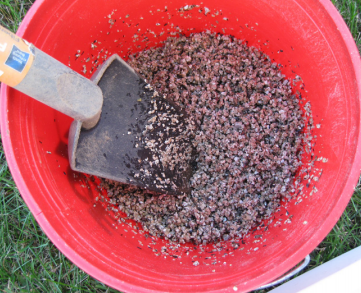
Mix the seed with vermiculite or other carrier for one subplot at a fourth dimension in a plastic pigment bucket or similar container. Start with the dry out carrier then add small amounts of water at a time, stirring until it is slightly damp only non wet. Now you can mix in your seeds; the small seeds will stick to the carrier particles, keeping everything well-mixed for distribution. Add the wildflower seeds showtime, then the grass seeds, calculation more than water or vermiculite if needed. The precise corporeality isn't of import, merely using 0.v to 1 gallon of the carrier per 500 square anxiety area is adequate. Wearing latex gloves will proceed the seed from sticking to your hands.
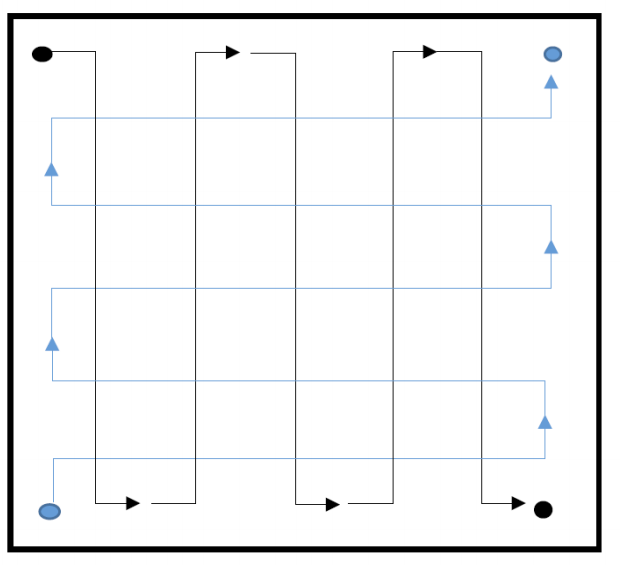
For each subplot, apply half the amount of seed while walking back and forth in i management, then repeat in the other management, as shown in the diagram below. Using a calorie-free-colored carrier such every bit vermiculite allows you to see how evenly yous accept distributed the mix on the soil surface. Besprinkle any remaining seed where needed.
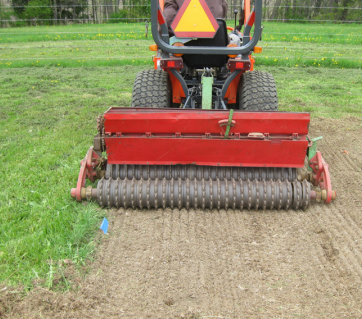
Raking lightly with a metal lawn or leaf rake after broadcasting helps work the seeds into the soil, merely rake only ¼" deep and so y'all do non coffin the tiny wildflower seeds. If the soil is firm and level, skip raking and get directly to rolling the area with a lawn roller, or a cultipacker, which will press the seed into the soil. Proficient seed to soil contact is essential for holding the seed in place over the winter and helps continue the seedlings from drying out once they germinate in the spring. And finally, a thin layer of make clean straw (one bale per 1000 square feet) distributed lightly over the tiptop helps continue the seed in place.
If seeding a big area (of several thousand square feet), yous might desire to try a mechanical seeder. A slitseeder or seed drill tin can be used on smooth level sites, such equally an agricultural field, only most people don't accept access to that equipment, which may besides be hard to calibrate. A whirlybird-type broadcast lawn seeder or chest-carried creepo seeder may work satisfactorily, but information technology is hard to keep the seed well-mixed and feeding properly; the tiny wildflower seeds tend to fall to the bottom and get used upward offset. Calibrate your seeder with a dry carrier (such every bit sand or rice hulls) before mixing in any seed. Then mix small batches of seed with the carrier, use half the amount going back and forth in 1 direction, then repeat in a perpendicular direction. In this example, do not add water to moisten the carrier, as information technology will prevent it from feeding through properly.

What to Expect
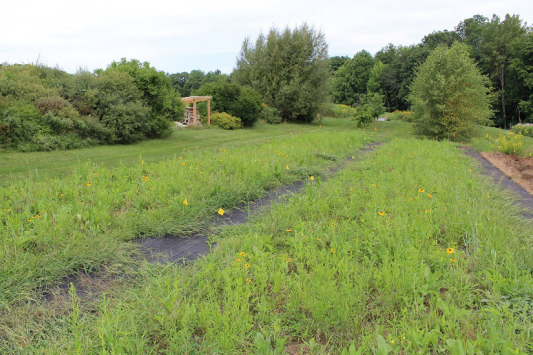
Yr 1 - is the flavor for site grooming, an essential but not very attractive procedure. Time and effort spent this year will provide a clean seedbed to exist planted and mulched in the fall or following spring. Skipping the site preparation process is sure to result in failure over the long run.
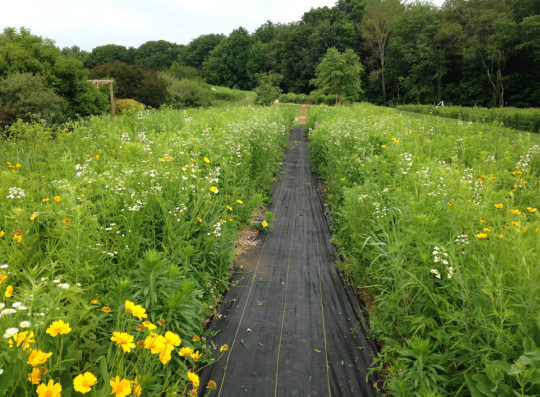
Year 2 – yous will most likely be disappointed in how your meadow area looks the first flavour later on planting. Patience is the cardinal this yr. You should see wildflower seedlings germinate and emerge equally the soil warms up in the spring, but it's hard to tell the wildflowers from the weeds at this point. Some wildflowers won't even germinate for 2-three years following planting, and almost abound low to the ground the first season. If you haven't done a dandy job of preparing the site and killing existing vegetation, weeds will grow up quickly and tin can easily smother or shade out the wildflowers. Mitt-weeding may disturb germinating wildflower seedlings, and then is not recommended. Consider mowing in mid-summertime at a 4-vi" mowing meridian, whacking the weeds back but going right over the top of most wildflower seedlings. Few wildflowers will bloom this year anyway, every bit they are devoting their energy to growing potent roots and shoots rather than flowers and seeds. Black-eyed Susan is the exception to the dominion, so exist sure to include information technology in your seed mix to provide cheerful yellow flowers this twelvemonth. It volition fifty-fifty recover and re-flower afterwards that mid-summer mowing.
Crabgrass is a special challenge on some sites. A thick coating of crabgrass can smother out germinating wildflowers, and is not sufficiently managed by mowing. There are few options for controlling crabgrass other than use of a post-emergent selective grass herbicides that tin be sprayed over-the-tiptop of wildflowers. One application to actively growing crabgrass earlier it goes to seed will effectively kill information technology, reopening the area to allow lite to reach the underlying wildflowers. As with all herbicides and other pesticides, follow label directions advisedly, and consider whether hiring a licensed applicator is required or prudent for the situation at mitt.
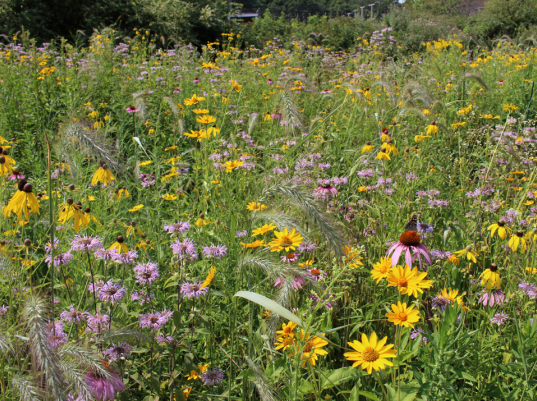
Yr 3 – If they survived last year, the wildflowers will sally quickly in the spring and grow much faster and larger this twelvemonth. Most weeds are slower to get started and pose much less of a trouble this year, oft beingness out-shaded and out-competed by a dumbo wildflower mix. Past late June, y'all should see some flowers on coreopsis and columbine, if they are in your mix, followed by foxglove beardtongue and blackeyed Susan. In mid-summer, wild bergamot (bee balm) and oxeye sunflowers will bloom prolifically, and mayhap a few xanthous and royal coneflowers will appear. Wild Rye shoots up and provides a pleasant contrast with its distinctive seed heads. Other warm-season grasses may notwithstanding be slow and camouflaged.
Year 4 and across – You and the bees volition reap the rewards of your efforts, enjoying a dense, diverse mix of colorful wildflowers from spring through late autumn, when goldenrods and asters provide a fall feast for bees. Black-eyed Susan, coreopsis and a few others will diminish in numbers and tend to migrate to the edges of your meadow. The mid-summer meadow buzzes with bees and other insect pollinators, and birds reap the benefit of bugs and seeds to swallow. Milkweed finds its place in the meadow, and monarchs feast on the nectar of many meadow flowers earlier laying their eggs on the undersides of milkweed leaves. Warm-flavor grasses fill in areas where the wildflowers are less dense, providing clumps that shelter ground-nesting bees and other creatures.
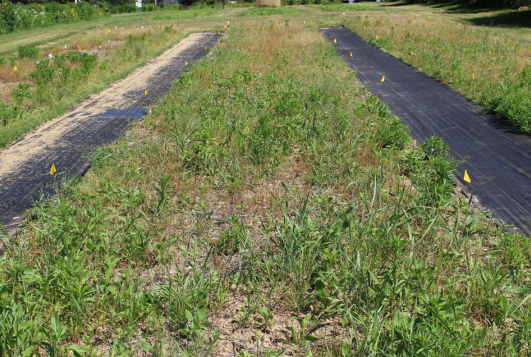
These photos show the growth and development of the same meadow planting over time.
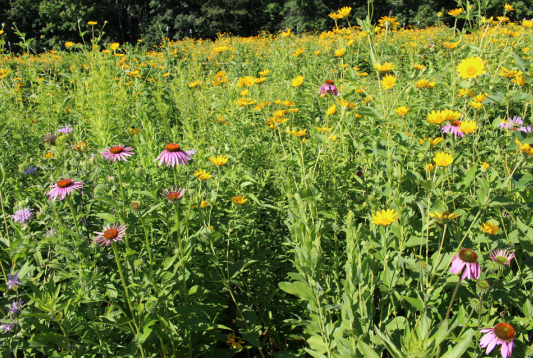
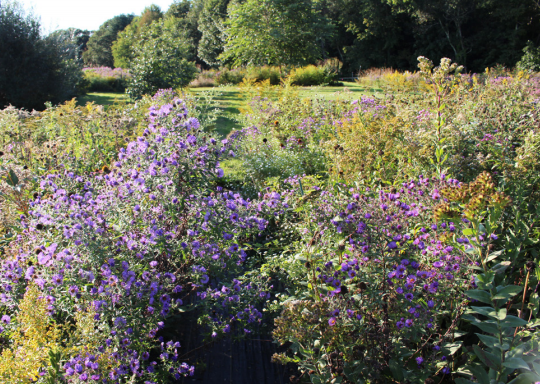
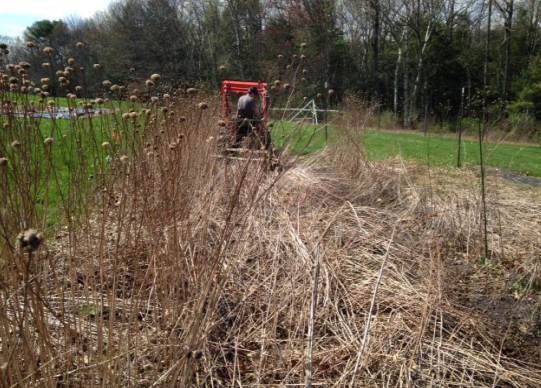
Long Term Changes and Maintenance
In one case you have an established meadow, there is lilliputian you lot demand to practice. Monitor for tall and aggressive weeds such as sumac, pokeberry, royal loosestrife and bittersweet vine, removing them by paw in the autumn when you can pull or wrench the roots out. Endeavor not to disturb the soil any more than necessary in the process, because disturbance creates openings for hereafter weeds and invasives. Yous can continue to edit the meadow past adding plants to thin areas and preventing some of our volunteer wildflowers (a.k.a. weeds) from taking over. Some to lookout man for include daisy fleabane, evening primrose and common mullein. These are all skillful pollinator plants but may outcompete some of the more than desirable species you planted, reducing diversity. Cut them back before they set seed will assistance proceed them in check.
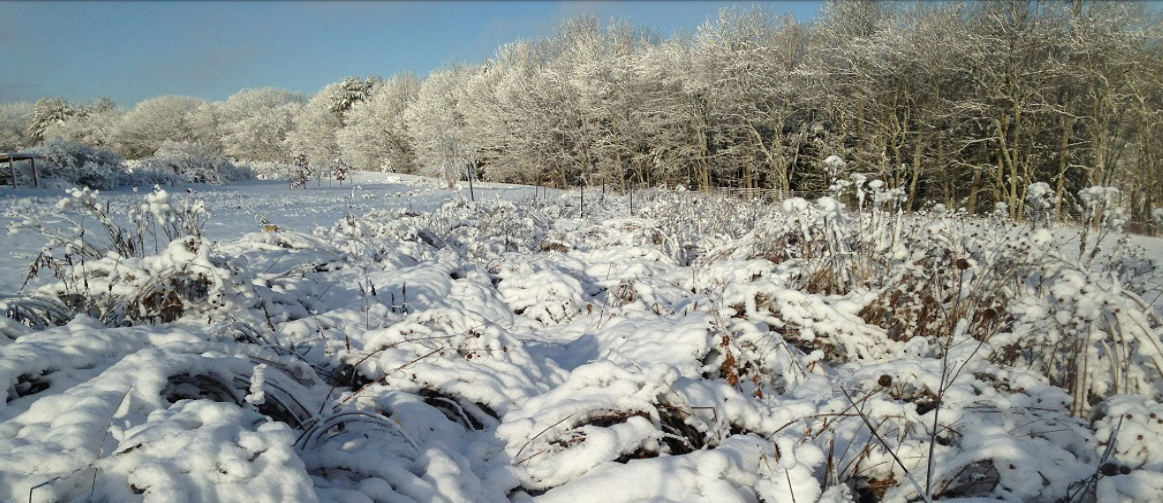
Once the meadow is finished flowering and freezes kill the last of the asters to the ground, consider the beauty in the structure and gilded colors of standing seed heads and grasses, which the birds will capeesh well into the winter. If you demand to tidy up, mow the meadow downwardly in Nov or go out information technology stand until early jump. Mow high (6-eight" or higher) and wild fauna will proceed to nest and forage in the meadow through the winter and spring. Mowing every yr is not required; its primary purpose is to discourage woody shrubs and trees from taking over. If yous accept a large meadow area, consider mowing merely one-third or one-quarter of it each year, leaving the rest for wintertime habitat.
The meadow is an ever-changing landscape. Weather variations, soil weather, and wildlife volition determine which wildflowers and grasses go dominant and which fade away over time. In a wet year, plants like Joe Pye-weed and cardinal flower may flourish, while in a dry year bergamot and coneflowers may grow. Take a pace back and relish the changes – a meadow is a process, not a product!
1 Seed Sources for New England Meadows. UNH Extension, 2018. https://extension.unh.edu/blog/seed-sources-new-england-meadows
Larn more almost wildflowers meadows, pollinator habitat and soil testing.
Acknowledgements: This work was funded past the USDA National Constitute of Food and Agriculture Hatch Multistate Project 1010449, with additional support from the Anna and Raymond Tuttle Environmental Horticulture Fund and the NH Horticultural Endowment. The author gratefully cheers Amy Papineau, Sean Fogarty, Sam MacNeil and the farm coiffure at the AES Woodman Horticulture Farm for all their help.
Source: https://extension.unh.edu/resource/planting-pollinators-establishing-wildflower-meadow-seed-fact-sheet
0 Response to "How To Plant Wildflowers On A Steep Slope"
Post a Comment